A law firm website wins clients when a stranger can tell within seconds what you handle, where you practice and how to reach you, and when Google and AI assistants can read that just as quickly. That takes custom design built around your practice areas, mobile-first layouts, accessibility, and search work done at the same time as the build. At IWD Marketing we have built websites since 1998, and we plan the design, the search setup and the AI visibility of a firm’s site as one project.
This guide covers what to put on the site, how to meet Florida’s advertising rules, how local and AI search depend on the build, and how to judge a quote.
Iwdesigners
iwdesigners.com
Build a Law Firm Website That Gets Found
IWD Marketing brings custom web design, SEO and AI-driven optimization together to help law firms improve online visibility and engagement.
Lead with practice areas, service locations and a visible phone number or contact button on every page, not buried in a menu.
Build mobile first: more than half of law firm site traffic likely comes from phones, according to the ABA.
Give each practice area its own thorough page. That is what search engines and AI tools can cite.
Florida lawyers: the website itself does not have to be filed with the Bar, but its content must follow the advertising rules, especially for testimonials and past results.
Plan design, SEO and accessibility together. Retrofitting any of them later costs more.
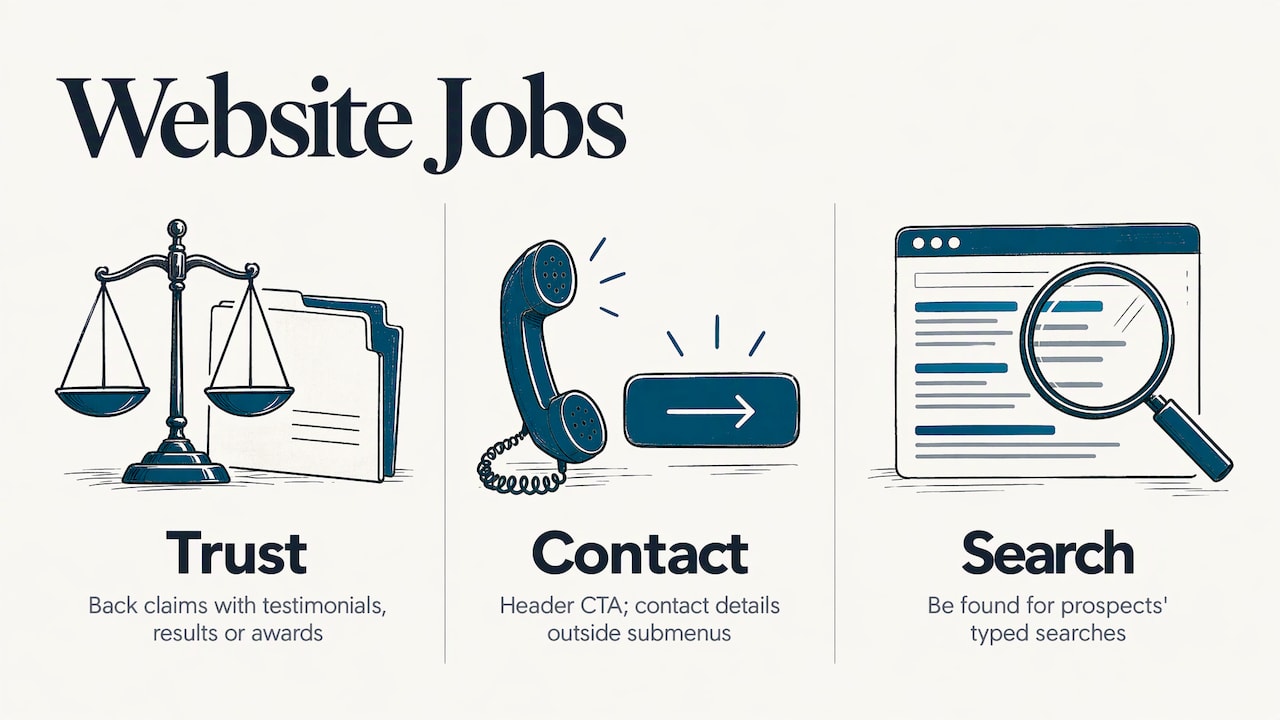
Your site has three jobs. It must make the right person trust you, make it easy to call or write, and be found for the searches that person types. A beautiful site that does only the first fails the other two.
The American Bar Association’s Law Practice Today describes the baseline: visitors should quickly understand what the firm does, where, and for whom. It also says to name specific practice areas, locations and client types, and to keep contact details out of a sub-menu. Calls to action should stand out, ideally in the header of every page, backed by testimonials, results, media mentions, association memberships or awards.
For a personal injury, family law or criminal defense client, the visit is often urgent and happens on a phone. That shapes every design choice below.
The pages that carry the work
Homepage
The ABA’s Business Law Today notes that search engines value the homepage more heavily than any other page. It should hold real content: an introduction to the firm, plus highlights from the rest of the site such as practice areas, reviews, case results, news and attorney introductions. A homepage that is only a slogan and a stock photo wastes the page with the most weight.
One page per practice area
The same ABA article advises firms that want traction in online marketing or AI visibility to publish a thorough page for each practice area instead of a single list of services. A page titled “Truck Accident Lawyer in Palm Beach County” can answer the questions of that client, name the courts and communities you serve, and rank for that search. A bullet in a services list cannot.
A solid practice area page usually includes:
A plain-language explanation of the legal problem and the process.
What the first consultation involves and what to bring.
The cities and counties you serve.
Attorneys who handle the matter, linked to their profiles.
Answers to the five or six questions clients actually ask.
A contact form and phone number within sight.
Attorney profiles
The ABA says profile pages are the most visited part of a law firm site after the homepage. It recommends recent professional headshots, a medium-length profile on experience, contact details and bulleted accomplishments. Treat each profile as a landing page: it is often where a referred prospect checks you out before calling.
Contact and intake
Short forms convert better than long ones in most service businesses, so ask for name, phone, email and a brief description of the matter. Make the phone number tappable on mobile. Confirm to the visitor what happens next and how soon someone will respond.
Mobile, speed and accessibility are part of the design
The ABA states that more than half of law firm website traffic is likely coming from mobile devices, so mobile-first design is critical. That means thumb-reachable buttons, readable type without zooming, forms that work on a small screen and pages that load quickly. Our responsive web design work starts from the phone layout and scales up to the desktop.
Accessibility belongs in the same conversation. The ABA’s Business Law Today article says business websites need to comply with Americans with Disabilities Act (ADA) requirements, so people with visual, auditory and physical disabilities can navigate, read and complete actions. Video and audio should have captions or transcripts. It also says accessibility should be built into code and design decisions from the start, which improves the experience for visitors and the way the site performs for AI agents and search engines.
A law firm has an added reason to care: you are asking the public to trust you with a legal problem, and a site that a visitor cannot operate undercuts that. Our web accessibility service covers this as part of the build rather than as an afterthought.
Florida lawyers: what the site’s content must respect
Rules 4-7.11 through 4-7.17 govern the content of a lawyer’s website, and the website does not have to be filed for review under Rule 4-7.20(g).
Information about past results must be factually verifiable and cannot omit facts that would make the results misleading.
Testimonials are prohibited unless they meet specific requirements. The person must be qualified to evaluate the lawyer, the testimonial must reflect that person’s actual experience and be representative of what clients generally experience, the lawyer may not write or draft it, and the person may receive nothing of value for it.
If a testimonial mentions results, the advertisement must carry a clear and conspicuous disclaimer that prospective clients may not obtain the same or similar results.
This changes how you design. A “Results” page needs space for verifiable context. Review widgets and testimonial sliders need a disclaimer where the testimonial appears. Your site should also make it easy for your team to update content without breaking those rules. A content management system your staff can edit, such as the ones in our content management systems work, keeps updates in your hands.
The handbook is the authority here, and your own compliance review remains yours. If a particular claim or testimonial is in doubt, the Florida Bar’s ethics staff or your firm’s ethics counsel is the right person to ask.
How the build supports law firm SEO
Search engine optimization (SEO) is the work of making your pages appear when prospects search. For lawyers, much of it is decided when the site is built.
Keyword research built around searches like “divorce lawyer in [your city]”.
Regular, informative content.
Local SEO with consistent name, address and phone number (NAP) and a Google Business Profile.
Mobile-friendly design.
Technical basics: compressed images, browser caching, minified code, HTTPS, clean URLs and schema markup (code that tells search engines what a page is about).
Those technical items are developer decisions. A template that ships with heavy scripts, uploads full-size photos and generates messy URLs makes each of them harder to fix later.
Local search for a county or city practice
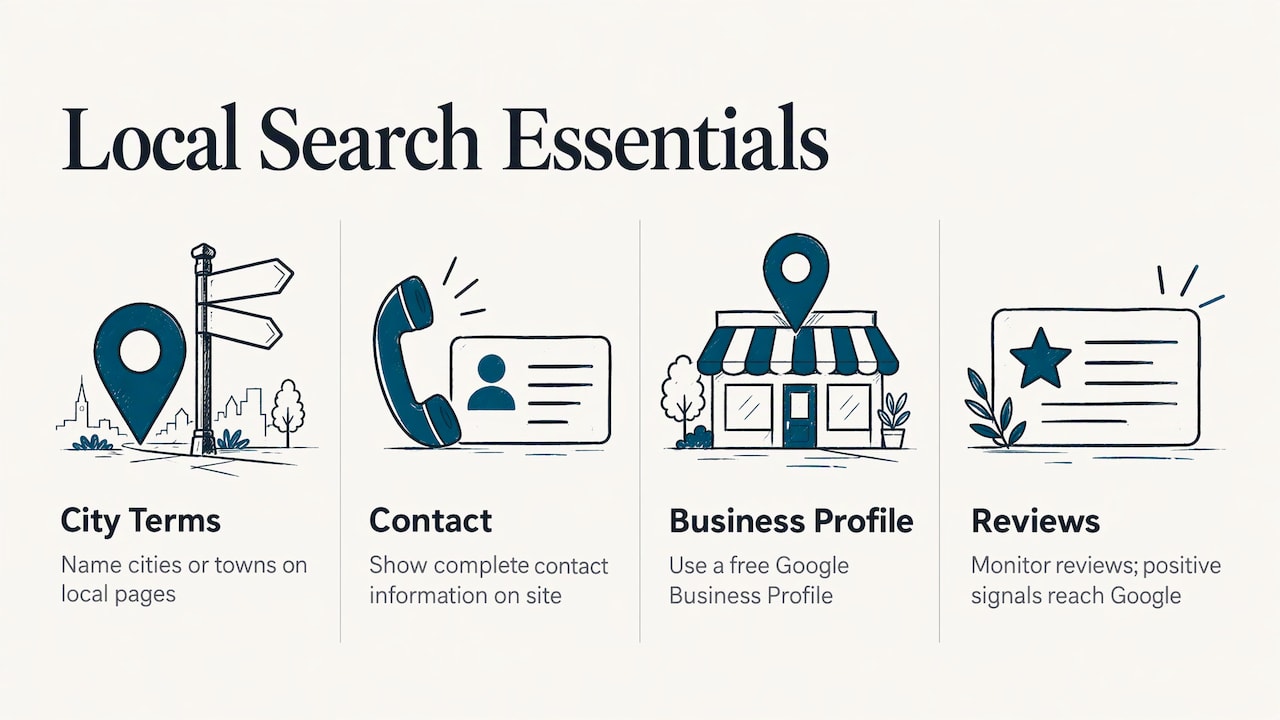
Most firms win clients within a defined area. The DC Bar outlines four local elements: local keywords that name a city or town, complete contact information on the site, a free Google Business Profile, and monitoring of reviews, since good reviews send positive signals to Google and to local prospects.
For a firm in Boca Raton, Jupiter or Palm Beach Gardens, that means separate pages for the places you actually serve, consistent details everywhere you are listed, and a steady habit of asking satisfied clients for reviews in a way that fits the Florida testimonial rules above. Our local search marketing team handles this work, and our search reputation management service covers how your firm appears when someone searches your name.
Content that earns the click
A blog post that answers “What happens after a car accident in Florida?” in plain words can bring in the person who is about to need you. Our content marketing service produces that kind of material, and our SEO service ties it to the keywords your practice areas should rank for.
AI search is now part of the brief
Prospects increasingly ask ChatGPT, Gemini, Perplexity or Google’s AI features for a lawyer or an explanation of a legal issue. The ABA’s guidance already connects thorough practice area pages with AI visibility, and accessible, cleanly coded sites perform better for AI agents as well as search engines.
That gives a practical test for any new site: could an AI tool read each practice page and understand who you are, what you handle and where? Clear headings, direct answers to common questions, schema markup and consistent firm details all help. We offer AI search services for law firms, including optimization for ChatGPT, Gemini, Perplexity and Google AI Overviews and AI Mode, so the website and AI visibility are planned together rather than bolted on.
Custom design or template?
Templates and prebuilt law firm platforms are quick to launch. A custom build lets the structure follow your firm: the practice areas you want to grow, the counties you serve and the intake process you actually use. Here is how the two compare on what matters to a firm.
Criterion
Template or prebuilt platform
Custom build
Page structure
Fixed layouts, your content adapts to them
Built around your practice areas and locations
Local pages
Often limited or duplicated
Unique page per area served
Mobile experience
Generic responsive layout
Designed phone first for your intake path
Florida Bar content rules
You adapt widgets yourself
Disclaimers and results formatting built into the layout
Accessibility
Varies by theme
Built into the code from the start
Growth
Constrained by the platform
New practice areas and features added as needed
If you want a site that competes for specific practice areas in a specific county, custom is the stronger foundation, and that is what we build.
What affects the cost of a law firm website
Prices for attorney sites vary widely, from monthly subscription platforms to five- and six-figure custom projects, because the scope behind the word “website” varies widely. The factors that move a quote are:
Number of pages. A solo practitioner with three practice areas needs far fewer pages than a multi-attorney firm with twelve.
Custom design versus template. Custom layout and development take more hours than adapting a theme.
Content writing. Practice area pages, attorney bios and FAQs written from scratch are a large share of the work.
SEO and AI setup. Keyword research, technical SEO, schema and local pages can be included in the build or bought later.
Accessibility work. Easier and cheaper when built in than when retrofitted.
Ongoing needs. Hosting, security, updates and content, which are recurring rather than one-time.
We do not publish prices, because the right quote depends on the factors above. We scope each project after learning your practice areas, locations and goals. Our website maintenance and web hosting services cover the recurring side so the site stays current after launch.
Choosing a web partner for your firm
Whatever route you take, ask these questions of anyone who will build your site:
Will each practice area and each location get its own page, with content written for it?
Is the site designed for phones first, and is accessibility part of the build?
Can your staff edit pages without a developer, and can the layout carry the disclaimers the Florida Bar rules require?
Is SEO planned into the structure, or sold as a separate project afterward?
Does the plan address AI search visibility?
Who maintains, hosts and updates the site after launch?
A partner that answers yes to all six has thought about the site as a client-acquisition tool rather than a brochure.
Where IWD Marketing fits
We have built websites and run digital marketing since 1998, and we are recognized as a top agency in South Florida. For law firms, we put the pieces in this article under one roof: custom web design, responsive and accessible builds, SEO, local search, content, reputation management and AI search optimization. Our approach is built around measurable outcomes, so you can see how the site performs once it is live.
If you are planning a new site or a rebuild, contact us through our site and tell us your practice areas and the counties you serve.
FAQ
How much does a law firm website cost?
It depends on page count, custom design versus a template, content writing, features and SEO scope. Subscription platforms sit at one end and custom projects at the other. We scope each project individually and do not publish a flat price.
Do Florida lawyers have to submit their website to the Florida Bar?
No. According to the Bar’s 2025 Advertising Handbook, the website does not have to be filed for review under Rule 4-7.20(g). Its content must still follow the rules on past results, testimonials and other advertising content.
What pages does a law firm website need?
A content-rich homepage, a thorough page for each practice area, attorney profiles, location information and an easy contact path. Calls to action should appear in the header of every page. Add testimonials and results only in a form that meets your jurisdiction’s advertising rules.
Does website design affect law firm SEO and AI search?
Yes. Page structure, mobile performance, clean URLs, schema markup and accessibility are all built into the site, and they influence how search engines and AI tools read it. Planning SEO with the design avoids rework later.

 Responsive Web Design
 Content Management Systems
 eCommerce
 Web Maintenance
 Web Hosting
 Web Accessibility


 SEO Search Engine Optimization
 PPC Pay-Per-Click
 SERM Search Reputation
 Local Search
 Social Media
 Mobile Marketing
 Content Marketing